
If you get frequent headaches and spend a lot of time hunched over a screen, the two may be more connected than you think. Yes, poor posture can absolutely cause headaches. When your head sits forward of your shoulders for hours at a time, it strains the muscles and joints at the base of your skull, and that strain can trigger what are known as cervicogenic headaches, meaning headaches that originate in the neck. Here’s how that connection actually works.
The Weight of Your Head
Start with a number that surprises most people. Your head weighs around 10 to 12 pounds, roughly the weight of a bowling ball. When your head is balanced properly over your shoulders, your neck and spine support that weight efficiently, the way a stack of blocks balances neatly on top of each other.
But here’s the problem. For every inch your head moves forward of that balanced position, the effective load on your neck increases substantially. A head that’s positioned a couple of inches forward, which is extremely common when looking at phones and screens, can place the equivalent of 20, 30, or more pounds of strain on the muscles and joints of your neck.
Those muscles at the back of your neck and the base of your skull now have to work constantly to hold your heavy head up against gravity. They’re not designed for that kind of sustained load, and over hours and days and years, it takes a toll.
How Neck Strain Becomes a Headache
This is the key mechanism. The muscles and joints at the top of your neck, in the upper cervical region just below your skull, have a direct relationship with the nerves that supply the head and face.
When forward head posture keeps those upper neck muscles chronically tight and overworked, and when the joints in that region become restricted and irritated as a result, the pain can refer up into the head. This is why a problem that originates in your neck ends up feeling like a headache. The pain typically starts at the base of the skull and wraps up and over, sometimes settling behind the eyes or around the temples.
These cervicogenic headaches are often mistaken for tension headaches or even migraines, because the head pain is what you feel most. But the source isn’t in your head at all. It’s in your neck, driven by the posture that’s straining it. Treating only the head symptoms, with pain relievers for instance, never addresses why the headaches keep coming.
Why This Is So Common Now
Forward head posture used to be mostly an issue for certain occupations. Now it’s nearly universal, and the reason is obvious if you look around any room.
We spend hours looking down at phones. We sit at desks and lean toward computer screens. We hunch over laptops and tablets. Every one of these positions pulls the head forward and down, and we hold them for a huge portion of our waking day. The posture that strains the neck and triggers cervicogenic headaches is now baked into how most of us live and work.
This is exactly why we see so many patients across Cedar Falls and Waterloo dealing with recurring headaches that trace back to their necks. Desk workers, students, anyone whose day revolves around screens is at risk. We covered the posture side of this in our piece on forward head posture in desk workers, and the headache connection is one of its most common consequences.
How to Tell If Your Headaches Are Posture-Related
Not every headache comes from the neck, but there are some patterns that point toward a cervicogenic cause.
Posture-related headaches often start at the base of the skull or in the neck before spreading up into the head. They tend to be worse after long periods of poor posture, like a full day at a desk or a long stretch on your phone. You may notice accompanying neck stiffness or tightness, and the headache is often one-sided or starts on one side. Turning or holding your head in certain positions may aggravate it.
If your headaches follow this kind of pattern, especially if they track with your screen time and desk hours, there’s a good chance your posture and neck are involved. That’s a very different situation from, say, a migraine with its own distinct triggers and characteristics, and it calls for a different approach.
Addressing the Cause, Not Just the Headache
Here’s the encouraging part. If your headaches are being driven by posture and upper neck strain, addressing that underlying cause can make a real difference, rather than just masking the symptom.
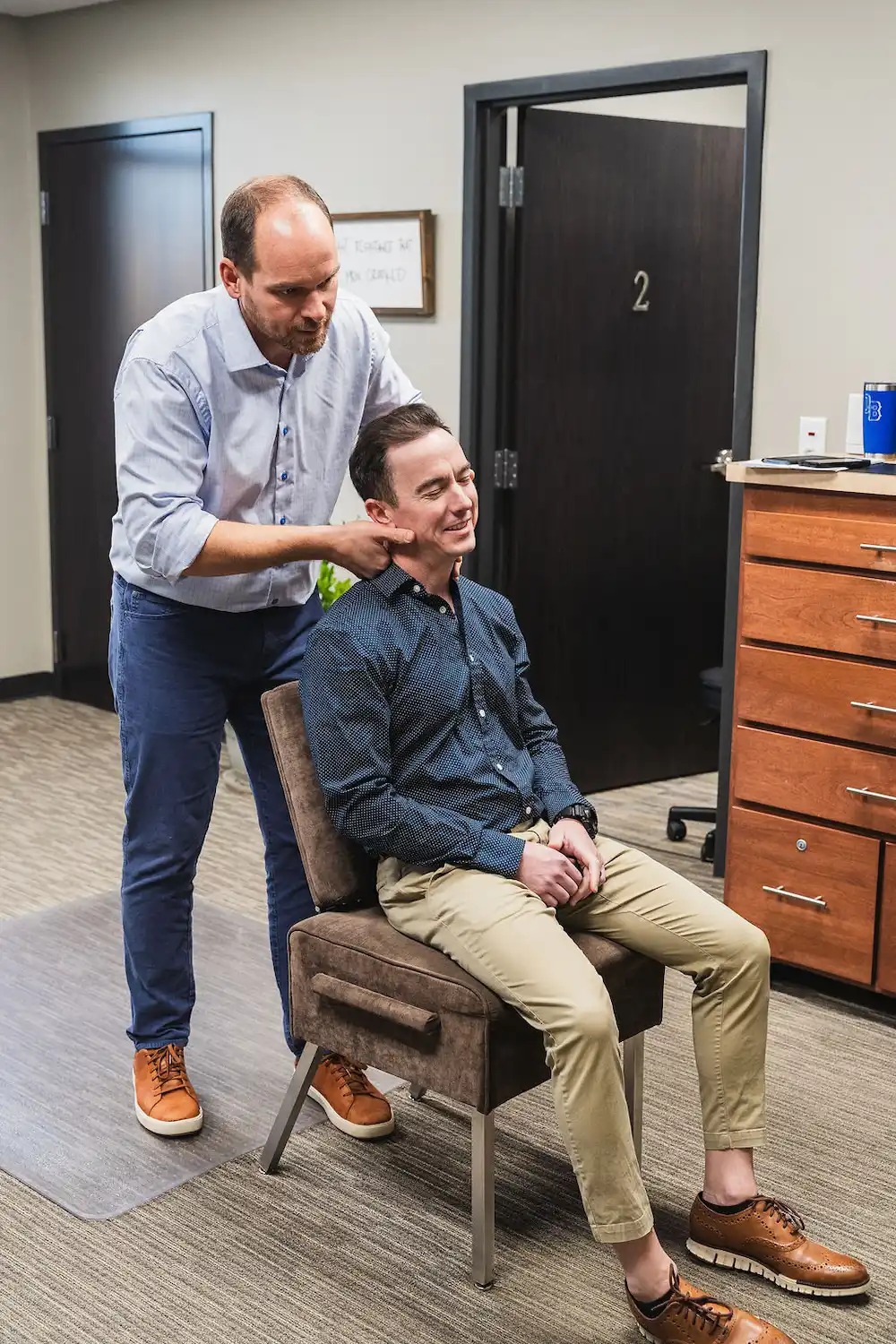
At our Cedar Falls practice, the Gonstead approach starts by identifying exactly what’s happening in the upper cervical spine. The 5-component analysis pinpoints which segments are restricted or misaligned and contributing to the muscle strain and nerve irritation behind the headaches. Correcting those specific segments relieves the restriction, reduces the nerve interference, and takes strain off the overworked muscles.
When the upper neck is functioning properly, the referred pain into the head often diminishes considerably. Many patients who came in thinking they just had to live with frequent headaches find real relief once the neck component is addressed. It’s one of those connections that, once you understand it, changes how you think about your headaches entirely.
What You Can Do About Your Posture
Alongside proper care, improving your posture helps prevent the strain from rebuilding. Set up your screens at eye level so you’re not constantly looking down. Take regular breaks from sitting and looking at devices, even just standing and moving for a minute or two every half hour or so. Be conscious of pulling your head back over your shoulders rather than letting it drift forward.
These habits won’t undo an existing restriction on their own, but they reduce the ongoing strain that keeps the problem going, which makes any care you receive more likely to hold.
Common Questions
Can bad posture cause migraines too?
Posture primarily drives cervicogenic headaches, which originate in the neck. That said, neck tension can sometimes act as a trigger for migraines in people who are prone to them, so addressing posture can help on that front as well.
How long does it take for posture-related headaches to improve?
It varies by person and how long the pattern has been established. Some people notice improvement fairly quickly once the neck restriction is addressed, while long-standing patterns take more time. A proper evaluation gives a realistic picture.
Are these headaches dangerous?
Cervicogenic headaches themselves are not dangerous, though they can significantly affect quality of life. That said, any sudden, severe, or unusual headache, or one accompanied by neurological symptoms, should be evaluated medically to rule out other causes.
If you’re getting frequent headaches and suspect your posture and neck are behind them, you don’t have to just keep reaching for pain relievers. Call Wayson Family Chiropractic at 319-266-1119 or schedule online, and we’ll find out whether your neck is the source with a thorough evaluation here in Cedar Falls.